
About the conference
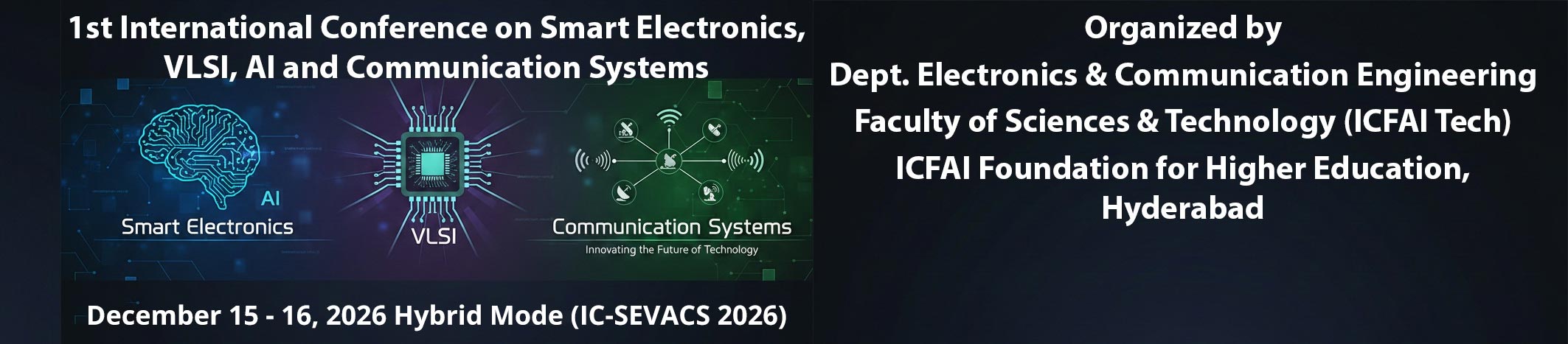
The 1st International Conference on Smart Electronics, VLSI, AI and Communication Systems (IC- SEVACS 2026) is scheduled to be held on 15th–16th December 2026 in hybrid mode at the ICFAI Foundation for Higher Education, Hyderabad, in association with the American Institute of Physics (AIP), Scopus-indexed proceedings. IC-SEVACS 2026 provides a premier platform for researchers, academicians, industry professionals, and students to present innovative research, exchange ideas, and explore technological advancements in smart electronics, communication systems, and artificial intelligence.
The conference emphasizes emerging and interdisciplinary areas such as Novel Nano devices, low- power VLSI Technology, Intelligent Embedded Systems, Internet of Things (IoT), Advanced Wireless communication technologies, cyber-physical systems, and AI for Next-Gen Technology.
The technical program includes keynote lectures by distinguished experts, invited talks, and peer- reviewed paper presentations. By fostering collaboration between academia and industry, IC- SEVACS 2026 aims to promote knowledge exchange, inspire innovative research, and contribute to the advancement of next-generation smart electronics and intelligent communication systems.
The Microsoft CMT service was used for managing the peer-reviewing process for this conference. This service was provided for free by Microsoft and they bore all expenses, including costs for Azure cloud services as well as for software development and support.
About Us
ICFAI Foundation for Higher Education (IFHE)
- The ICFAI Foundation for Higher Education is a deemed-to-be-university established under Section 3 of the UGC Act, 1956.
- IFHE's comprehensive student-centric learning approach provides relevant knowledge, imparts practical skills, and inculcates a positive attitude among the students.
- Today, the IFHE is one of the largest multi-disciplinary universities in the country.
- The ICFAI Business School, Faculty of Science and Technology, Faculty of Law , ICFAI School of Architecture, ICFAI School of Social Sciences and Center for Distance and Online Education are the six core academic schools of the university
- IFHE has been permitted by the Ministry of Education, Government of India, to start an Off-Campus Center at Bangalore, Karnataka.
- The University is a member of the Association of Indian Universities (AIU) and the Association of Commonwealth Universities (ACU).
- The University offers students the best and updated curriculum and trains them for rewarding careers.
- It promotes a culture of research that advances knowledge in the field of management, technology, law, architecture, and social sciences.
- IFHE is a Category I Autonomous Institution, and Accredited by NAAC with 'A++' Grade
About Faculty of Science and Technology (IcfaiTech)
Faculty of Science and Technology (IcfaiTech), Hyderabad, is a constituent of the ICFAI Foundation for Higher Education. It has been established to promote quality education in the field of Science and Technology. IcfaiTech strives to acquire a reputation as a highly purposeful and innovative institution, setting the pace for workable reforms in professional education that are suitable and most relevant to the Indian cultural milieu.
The core philosophy of education at IcfaiTech is to empower students with the proper knowledge and modern skill sets, so that they are ready to face the challenges of the competitive world. IcfaiTech strives to provide its students with the fine edge required to make a successful professional. The programs at IcfaiTech have been uniquely designed by incorporating courses from diverse areas, including humanities, arts, and management, combined with science, engineering, and industry- based internships. IcfaiTech ensures that students gain exposure and knowledge across different disciplines, develop inter-personal skills and leadership qualities that take them beyond traditional thinking and practice.
The educational philosophy and practices at IcfaiTech allow it to integrate an innovative and emerging body of knowledge into its learning system. The highlights of the academic program are summarized below:
- Cutting-edge course curriculum with contemporary and effective pedagogic methods that emphasize application-oriented learning.
- Encouraging students to not only articulate Science and Technology needs but also provide appropriate solutions.
- Developing appreciation for synthesized multidisciplinary learning by way of workshops, internships, and other group learning assignments
About the Department of Electronics and Communication Engineering (ECE)
The Department of Electronics and Communication Engineering (ECE) at the ICFAI Foundation for Higher Education, Hyderabad is committed to excellence in teaching, research, and innovation in the fields of electronics, communication systems, and emerging intelligent technologies. The department offers a dynamic learning environment for undergraduate, postgraduate, and research students, integrating strong theoretical foundations with practical, hands-on training in modern electronics and communication engineering.
With a focus on cutting-edge research and industry-relevant skill development, the department covers a wide range of areas including VLSI design, embedded systems, IoT, AI/ML for electronics, communication networks, signal processing, and smart instrumentation. The department encourages interdisciplinary collaboration, promotes innovation through labs and research centers, and fosters a culture of critical thinking, problem-solving, and entrepreneurial mindset.
The faculty team comprises experienced academicians and industry experts actively engaged in research, consultancy, and knowledge transfer. The department maintains strong industry linkages and collaborative projects, ensuring students gain exposure to real-world applications and emerging technologies. Through its academic rigor and research initiatives, the Department of ECE aims to empower students and researchers to become leaders in electronics and communication engineering globally.
Centres and Research Labs – Department of ECE
1. Center for Advanced Nanofabrication and Characterization (CaNFAC):Advanced State-of-the-Art Semiconductor Fabrication and Research Facility equipped with thin film deposition, oxidation, diffusion, annealing furnaces, metallization setup, and CV-IV characterization tools. The laboratory supports research in MOSFET devices, dielectric studies, and emerging Si and perovskite solar cell technologies.
2. Centre for VLSI: Established under MeitY’s C2S Scheme, offering industry-standard EDA tools (Synopsys, Xilinx, Silvaco, ADS, (liosoft) for advanced VLSI design and hands-on training.
Call for Papers – IC-SEVACS 2026
High-quality research papers for presentation and publication Conference Proceedings. The conference encourages contributions that address emerging trends, innovations, and applications across electronics, VLSI, communication systems, embedded/IoT systems, and AI-enabled intelligent technologies.
Track 1: Electronic and Nano-Materials
Focus on advances in materials that underpin next-generation electronics and devices.
- Advanced semiconductor materials: Si, Ge, GaN, ZnO
- 2D materials: graphene, MoS₂, phosphorene
- Dielectric, ferroelectric, and piezoelectric materials
- Thin-film deposition and lithography techniques
- Nanowires, nanotubes, and quantum dots
- Inorganic /Organic semiconductors
- 3D IC Integration
- Flexible, wearable, and sustainable electronic materials
Track 2: Semiconductor Devices & Device Modelling
Covers fundamentals and innovations in device physics, modelling, and simulation.
- MOSFET, FinFET, GAAFET, HEMT, NSFET, NCFET and emerging transistors
- Device fabrication challenges and experimental studies
- Compact and physics-based modelling, TCAD simulations
- AI/ML-assisted device modelling and parameter extraction
- Reliability, performance optimization, and variability analysis
- Inorganic /Organic solar cell devices
Track 3: VLSI Design and Embedded Systems
Explores design, optimization, and application of integrated circuits and embedded systems.
- CMOS digital, analog, and mixed-signal design
- Low-power and high-performance VLSI architectures
- FPGA, ASIC, and SoC design methodologies
- Hardware-software co-design and verification
- Embedded microcontrollers and real-time systems
- Firmware development for IoT and automation
- VLSI testing, fault tolerance, and reliability
- AI/ML accelerators and hardware optimization
Track 4: Internet of Things (IoT) and Smart Sensors
Covers architecture, applications, and intelligence in IoT-enabled systems.
- IoT system architectures, protocols, and platforms
- Edge, fog, and cloud computing integration
- Smart sensors for healthcare, industry, and environment
- Sensor networks, fusion, and distributed intelligence
- Low-power and energy-efficient IoT systems
- AI-enabled IoT and embedded intelligence
- Industrial IoT, smart cities, and smart agriculture
- Security, privacy, and reliability in IoT networks
Track 5: Communication Systems
Focus on modern communication networks, devices, and signal processing techniques.
- 5G, 6G, and next-generation wireless communication
- RF and microwave circuit design
- Optical communication and photonic devices
- Antenna design, propagation, and MIMO systems
- Signal processing for communication systems
- Wireless sensor network communication protocols
- Cognitive and software-defined radios
- AI/ML-enabled communication system optimization
Track 6: Artificial Intelligence and Intelligent Systems
Explores AI, ML, and intelligent approaches applied to electronics, embedded systems, and communication.
- AI/ML for device modelling and VLSI design
- Intelligent embedded and IoT systems
- Edge AI and hardware acceleration
- Cyber-physical and autonomous systems
- Predictive analytics and fault detection
- Deep learning for signal, image, and data processing
- AI-driven industrial automation and robotics
- AI-enabled optimization of communication and intelligent systems
- AI/ML for sustainable developments
Submission Guidelines:
- Authors are invited to submit original, unpublished research papers.
- All submissions will undergo peer review for originality, technical quality, and relevance.
- Accepted papers will be published in AIP Conference Proceedings - Scopus Indexed

Selected articles will be published in
- Journal of Electronic Materials , Springer (https://link.springer.com/journal/11664) -SCIE
- Analog Integrated Circuits and Signal Processing, Springer (https://link.springer.com/journal/10470) -SCIE
Instructions to Authors:
Full paper in AIP format should be submitted through on-line paper submission process of (Microsoft CMT). Manuscripts for IC-SEVACS 2026 will ONLY be accepted in electronic format through Microsoft CMT online submission Portal.


At least one author of the accepted paper is required to be registered.
Important Dates:
| Event | Date |
|---|---|
|
Paper Submission Deadline Full Paper Submission in AIP Conference Proceedings Format Available Online at: https://pubs.aip.org/aip/acp/pages/preppapers |
7th October 2026 |
| Acceptance Notification | 31st October 2026 |
| Camera-Ready Submission | 30th November 2026 |
| Conference Dates | 15th – 16th December 2026 |
Conference Committee
Chief Patron
Prof. (Dr.) A Vinay Kumar
Vice Chancellor, ICFAI Foundation for Higher Education, Hyderabad.
Patrons
Prof. S. Vijaya Lakshmi
Registrar, ICFAI Foundation for Higher Education, Hyderabad.
Prof. K. L. Narayana
Director (FST), ICFAI Foundation for Higher Education, Hyderabad.
Organizing Chair and Convener
Dr. Asisa Kumar Panigrahy
Associate Professor (Dept. of ECE), ICFAI Foundation for Higher Education, Hyderabad.
General Chair
Dr. Trupti Ranjan Lenka
NIT Silchar
Dr. Kousik Midya
ICFAI Foundation for Higher Education, Hyderabad.
Publication Chair
Dr. Raghunandan Swain
PMEC Bam, Govt. of Odisha
Publication Committee
Dr. Sudheer Hanumanthakari
IFHE Hyderabad
Dr. Rajesh Kumar Jha
IFHE Hyderabad
Dr. Soumit Samadder Chaudhury
IFHE Hyderabad
Dr. M Sandhya
IFHE Hyderabad
Steering Committee
Dr. Digvijay V Nair
IFHE Hyderabad
Dr. Syed Shakeel Hashmi
IFHE Hyderabad
Dr. Padavala Akhendra Kumar
IFHE Hyderabad
Dr. P Pavan Kumar
IFHE Hyderabad
TPC Committee
Dr. V. A. Sankar Ponnapalli
IFHE Hyderabad
Dr. N. Prasad
IFHE Hyderabad
Mr. Madhu Sudhakar Endla
IFHE Hyderabad
International and National Advisory Board Members
Prof. Dong-Won Kim
Samsung Institute of Technology, Korea
Prof. Hieu P.T. Nguyen
TTU, USA
Prof. Nguyen Truong Khang
TDTU, Vietnam
Prof. Pham Tan Thi
HCMUT, Vietnam
Prof. Basuki Rachmatul Alam
Indonesia
Prof. Asrulnizam Bin
USM, Malaysia
Prof. P. Susthitha Menon
UKM, Malaysia
Dr. Jacopo Iannacci
FBK, Italy
Dr. Olga Jaksic
University of Belgrade – ICTM, Serbia
Dr. Shuji Ikeda
Tei Solutions Inc., Japan
Prof. Kuan-Neng Chen
National Yang Ming Chiao Tung University, Taiwan
Prof. Amit Krishna Dwivedi
University of Warwick, UK
Prof. Vilas Gaidhane
BITS Pilani Dubai
Prof. U. B. Desai
Advisor, IFHE, Hyderabad
Dr. J. Mahendar Reddy
Advisor, ICFAI Group
Dr. O. R. S. Rao
Advisor, ICFAI Group
Prof. Shiv Govind Singh
IIT Hyderabad
Prof. Kuan-Neng Chen
National Yang Ming Chiao Tung University, Taiwan
Prof. Suresh Kumar Garlapati
IIT Hyderabad
Prof. Abhinav Kumar
IIT Hyderabad
Prof. Rahul Jashvabtbhai Pandya
IIT Dharwad
Prof. Ambika Prasad Shah
IIT Jammu
Prof. Pardeep Duhan
IIT Ropar
Prof. Rajeev Kumar Ranjan
IIT (ISM) Dhanbad
Dr. Niranjan Raj
IISc Bangalore
Prof. Sarangam K
NIT Warangal
Prof. Satish Chandra
Motilal Nehru National Institute of Technology Allahabad
Prof. Amit Krishna Dwivedi
University of Warwick, UK
Prof. Rakesh Vaid
University of Jammu
Prof. Chandan Kumar Sarkar
Jadavpur University
Prof. Gananath Dash
Sambalpur University
Prof. Kamala Kant Mahapatra
NIT Rourkela
Dr. Saroj Mondal
IIT Dharwad
Prof. N. Bheema Rao
NIT Warangal
Prof. B. Naresh Kumar Reddy
NIT Tiruchirappalli
Dr. Raghunandan Swain
PMEC Berhampur
Prof. Sreehari Rao Patri
NIT Warangal
Prof. Mohammad Hasan
AMU, Aligarh
Prof. Roy Paily Palathinkal
IIT Guwahati
Prof. Kamaljit Rangra
CSIR- CEERI, Pilani
Prof. A. K. Panda
VVDN Technologies
Prof. Sudeb Dasgupta
IIT Roorkee
Prof. Mridula Gupta
DU, Delhi
Prof. Satyabrat Jit
IIT BHU
Prof. Hieu P.T. Nguyen
NJIT, USA
Prof. Nguyen Truong Khang
TDTU, Vietnam
Prof. Pham Tan Thi
HCMUT, Vietnam
Prof. P. Susthitha Menon
UKM, Malaysia
Prof. Lei Zuo
Virginia Tech, USA
Dr. Fuccio CRISTIANO
LAAS-CNRS, France
Dr. Jacopo Iannacci
FBK, Italy
Dr. Olga Jaksic
University of Belgrade – ICTM, Serbia
Dr. Shuji Ikeda
Tei Solutions Inc., Japan
Dr. J. Ajayan
SR University
Dr. M.Durga Prakash
SRM University-AP
Technical Program Committee
Dr. Sheikh Aamir Ahsan
NIT Srinagar
Dr. Preetisudha Meher
NIT Arunachal Pradesh
Dr. Prabina Pattanayak
NIT Silchar
Dr. Kumar Prasannjit Pradhan
IIITDM, Kancheepuram
Dr. V. Bharath Sreenivasulu
Research Scientist, Manipal Institute of Technology Bengaluru
Prof. Fazal A. Talukdar
NIT Silchar
Prof. Srimanta Baishya
NIT Silchar
Prof. Krishna Lal Baishnab
NIT Silchar
Prof. Rabul Hussain Laskar
NIT Silchar
Dr. Soumyaranjan Routray
SRM University, Chennai
Dr. Deepak Kumar Panda
Amrita Vishwa Vidyapeetham, Amaravati
Dr. Chandan Kumar Pandey
VIT-AP University, Amaravati
Dr. Biraj Shougaijam
MT University, Imphal
Dr. Richik Kashyap
Assam University, Silchar
Dr. Kanjalochan Jena
LNMIIT, Jaipur
Dr. Rupam Goswami
Tezpur University, Assam
Dr. Rajesh Saha
MNIT, Jaipur
Dr. B Anil Kumar
KL University
Dr. Dinesh Kumar Dash
PMEC Odisha
Dr. Satya Sopan Mahato
NIST Odisha
Prof. Sanjay Agrawal
IGNOU, New Delhi
Prof. Angsuman Sarkar
Kalyani GEC, WB
Prof. Santosh Gupta
MNNIT, Allahabad
Prof. Mohan Kumar
GITAM University, Bangalore
Prof. Brijesh Kumar
IGDTUW, Delhi
Dr. Arunanshu Mahapatro
VSSUT Burla, Odisha
Registration Fees
| Category | Early Bird Registration | Late Registration | ||
|---|---|---|---|---|
| Indian | International | Indian | International | |
| Academicians / Scientists | INR 11,000 | USD 150 | INR 12,000 | USD 200 |
| Industrial | INR 13,000 | USD 250 | INR 14,000 | USD 300 |
| Attendees | INR 2,500 | USD 50 | INR 3,000 | USD 75 |
*An additional 18% GST will be applied to the registration fee mentioned above.
*Registration details and mode of payment will be updated soon.
Sponsors
Will be updated soon...
Speakers

Prof. Amit Krishna Dwivedi
University of Warwick, UK

Prof. Kuan-Neng Chen
National Yang Ming Chiao Tung University, Taiwan

Dr. Charles Zhang
CEO, Shenzhen HUASEMI Electronics Co. LTD.,
Shenzhen, China

Prof. Shiv Govind Singh
IIT Hyderabad

Prof. Ambika Prasad Shah
IIT Jammu

Dr. Asrulnizam Bin Abd Manaf
Universiti Sains Malaysia (USM), Malaysia

Ms. Manini Gaur
NXP Semiconductors
Contact Us:
Dr. Asisa Kumar Panigrahy
Convener, and Organizing Chair
Dept. of ECE, Faculty of Science & Technology (IcfaiTech), IFHE Hyderabad
E-Mail: asisa@ifheindia.org
Mobile: +91-9398446780
Dr. Kousik Midya
General Chair
Dept. of ECE, Faculty of Science & Technology (IcfaiTech), IFHE Hyderabad
E-Mail: kmidya@ifheindia.org
Mobile: +91-9599442978