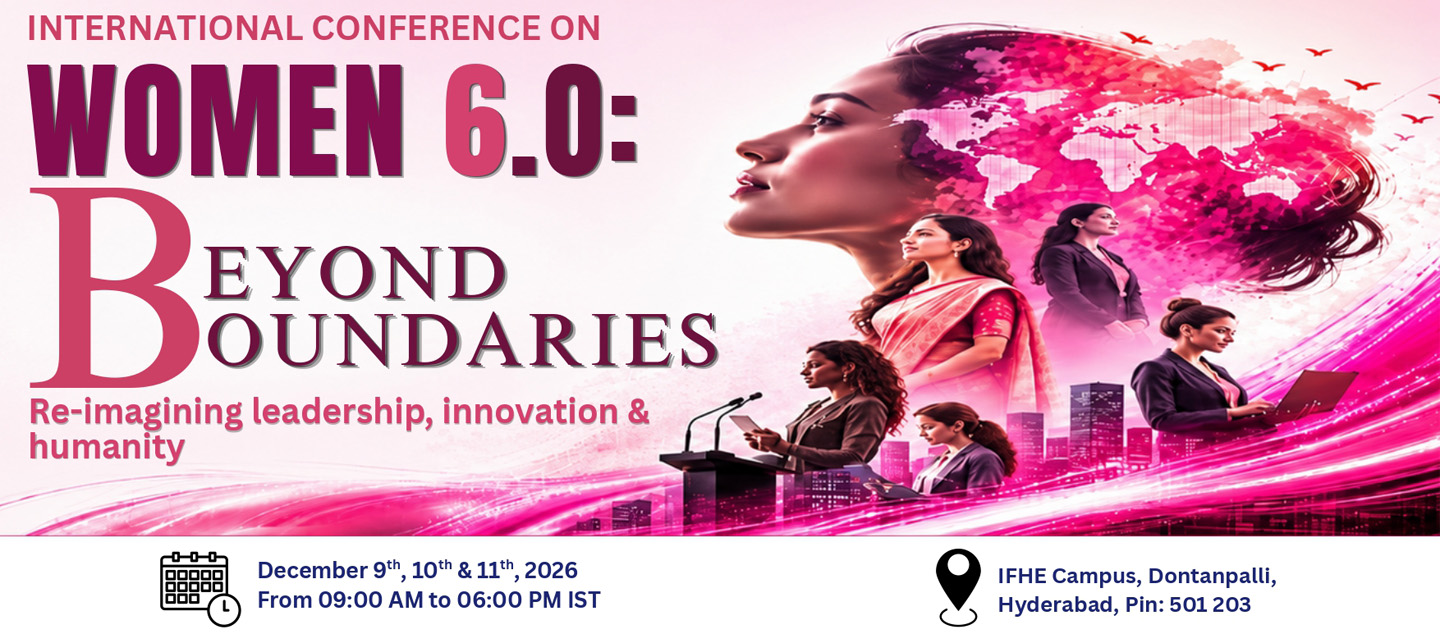
Major Conference Themes & Sub-Themes
THEME 1: Women & the Future of Leadership in an AI World
Sub Themes
1. AI-assisted leadership and decision-making
2. Ethical leadership in algorithmic governance
3. Women CEOs and boardrooms in Industry 6.0
4. Emotional intelligence vs artificial intelligence
5. Women leaders in public policy and administration
6. Crisis leadership in an uncertain world
7. Inclusive leadership models beyond hierarchies
8. Redefining power in digital organizations
9. Women and global institutional leadership
10. Mentoring future women leaders in AI-era
THEME 2: Women, Technology & Human-Centered Innovation
Sub Themes
1. Women as creators of AI, not just users
2. Gender bias in algorithms and data systems
3. Human-centered design and responsible tech
4. Women in deep tech, robotics, and automation
5. Cybersecurity, privacy, and women’s safety
6. Women technologists shaping digital futures
7. Tech for social good and inclusive growth
8. Women-led innovation ecosystems
9. Ethics, empathy, and explainable AI
10. Digital inclusion and access for women
THEME 3: Women, Law, Justice & Digital Governance
Sub Themes
1. AI, law, and future of justice delivery
2. Women shaping cyber laws and digital rights
3. Gender justice in digital spaces
4. Constitutional values in technology
governance
5. Women judges, advocates, and policymakers
6. Human rights in algorithm-driven societies
7. Legal frameworks for AI accountability
8. Women and alternative dispute resolution
9. Technology, surveillance, and civil liberties
10. Global legal cooperation and women’s
leadership
THEME 4: Women, Agriculture & Food Security in a Changing Climate
Sub Themes
1. Women farmers and agri-innovation
2. AI and precision agriculture led by women
3. Climate resilience and sustainable
farming
4. Women and food supply chain leadership
5. Indigenous knowledge and women
cultivators
6. Digital tools for rural women empowerment
7. Women in agri-entrepreneurship
8. Nutrition, health, and food justice
9. Policy support for women in agriculture
10. Future of farming and women-led
solutions
THEME 5: Women, Environment & Sustainable Futures
Sub Themes
1. Women as custodians of natural
resources
2. Climate leadership and environmental
governance
3. Sustainable cities and women planners
4. Green technologies and women
innovators
5. Women-led climate action movements
6. Circular economy and sustainability
7. Environmental justice and inclusion
8. Disaster management and resilience
9. Policy frameworks for sustainable
development
10. Women shaping planetary
responsibility
THEME 6: Women, Media & the Power of Narratives
Sub Themes
1. Women shaping digital and mainstream
media
2. AI, deepfakes, and media ethics
3. Representation of women in global
media
4. Social media influence and
responsibility
5. Women journalists and truth in the AI
age
6. Media as a tool for social
transformation
7. Women storytellers and cultural
change
8. Political communication and women
voices
9. Combating misinformation and bias
10. Media literacy and democratic
discourse
THEME 7: Women, Politics & Democratic Transformation
Sub Themes
1. Women in electoral politics and
governance
2. AI in political campaigns and
policy-making
3. Grassroots leadership and women
participation
4. Women shaping inclusive
democracies
5. Ethics, transparency, and
accountability
6. Women in diplomacy and global
relations
7. Youth, politics, and women
mentors
8. Political leadership beyond
tokenism
9. Gender-responsive public
policy
10. Future of democracy and women
leadership
THEME 8: Women, Education & Knowledge Futures
Sub Themes
1. AI-driven education and women
educators
2. Women shaping future
curricula
3. Lifelong learning in Industry
6.0
4. Digital universities and
access
5. Women as researchers and
knowledge creators
6. Ethics in education
technology
7. Inclusive education
models
8. Leadership in higher
education
9. Mentorship and academic
governance
10. Education as a tool for
societal change
THEME 9: Women, Entrepreneurship & Inclusive Economies
Sub
Themes
1. Women-led startups and
innovation
2. AI-enabled
entrepreneurship
3. Access to finance and
women founders
4. Social entrepreneurship
and impact
5. Women in MSMEs and
informal sectors
6. Policy ecosystems for
women entrepreneurs
7. Global markets and women
enterprises
8. Sustainable business
models
9. Risk-taking and
resilience
10. Women redefining
economic success
THEME 10: Women, Humanity & the Ethics of the Future
Sub
Themes
1. Technology with
compassion and care
2. Ethics, empathy, and
leadership
3. Women as moral
anchors of society
4. Human values in a
machine-driven world
5. Mental health,
well-being, and
leadership
6. Intergenerational
responsibility
7. Cultural wisdom and
modern challenges
8. Peacebuilding and
conflict resolution
9. Women shaping humane
futures
10. Redefining progress
beyond GDP
Women Transformation From 1.0 to 6.0
- 1.0 Traditional roles and struggles for basic rights
- 2.0 Women entering education and workforce
- 3.0 Fighting for equality, leadership, and representation
- 4.0 Digital empowerment, breaking stereotypes, and leading change
- 5.0 Beyond equality: Women driving innovation, policy, and shaping the future across industries, technology, governance, and social structures in the era of AI
- 6.0 Beyond Boundaries: Reimaging Leadership, Innovation & Humanity
About ICFAI Foundation on For Higher Education (IFHE)
- The ICFAI Foundation on for Higher Education on is a deemed-to-be-University established under sec on 3 of UGC Act, 1956.
- IFHE's comprehensive student-centric learning approach provides relevant knowledge, imparts practical skills and inculcates a positive attitude among the students.
- Today, IFHE is one of the largest multi-disciplinary universities in the country.
- The Faculty of Management, Faculty of Science and Technology and Faculty of Law , Faculty of Architecture, Faculty of Social Sciences and Center for Distance and Online Education are the six core academic schools of the university.
- IFHE has been permitted by the Ministry of Education, Government of India, to start an Off-Campus Centre at Bangalore, Karnataka.
- The University is a member of the Association of Indian Universities (AIU) and Association of Commonwealth Universi es (ACU).
- The University, offer students the best and updated curriculum and train them for rewarding careers.
- It promotes a culture of research that advances knowledge in the field of management, technology, law, architecture and social sciences.
- IFHE is Category I Autonomous Institution, and Accredited by NAAC with 'A++' Grade
About Center For Women Development (CWD)
The Centre for Women Development at ICFAI Foundation for Higher Education (IFHE) has been established as a Center of Excellence dedicated to advancing the cause of women's empowerment, leadership, and development. Recognizing the vital role women play in shaping the future of society, CWD aims to be a driving force in promoting gender equity, nurturing talent, and addressing challenges faced by women across diverse spheres. The Center serves as a dynamic platform for academic inquiry, action-oriented research, advocacy, and community engagement focused on women-related issues. The activities of CWD are thoughtfully designed to foster dialogue, awareness, and meaningful action. It regularly organizes national and international seminars, conclaves, conferences, workshops, and capacity-building programs that bring together academicians, researchers, industry leaders, policymakers, and civil society. The Center is committed to generating and disseminating knowledge through scholarly articles, edited volumes, and books. It also collaborates extensively with national and international women's organizations, government bodies, NGOs, industry stakeholders, and thought leaders to drive impactful initiatives aimed at empowering women in the campus, nearby communities, and society at large.
About the Conference
A natural upgrade from Women 5.0 with a futuristic limitless theme
Women 6.0 - Beyond Boundaries is an international, interdisciplinary conference envisioned as a global platform to deliberate on the evolving role of women in shaping a rapidly transforming world. Building on the legacy of Women 5.0: Power, Progress & Possibilities, this edition acknowledges that empowerment alone is no longer sufficient. The challenges of the future demand leadership that is intelligent, ethical, inclusive, and deeply human. By December 2026, Artificial Intelligence and advanced technologies will permeate governance, business, law, education, agriculture, media, and daily life. Women 6.0 explores how women can guide this transformation responsibly, ensuring that innovation serves humanity rather than displacing it. The conference foregrounds women as leaders who bridge data with empathy, growth with sustainability, and power with purpose The conference adopts a holistic framework encompassing leadership, technology, law, agriculture, environment, media, politics, education, entrepreneurship, and ethics. It brings together academicians, policymakers, industry leaders, technologists, social thinkers, and young scholars to engage in meaningful dialogue, research exchange, and solution-building. Women 6.0 positions women not merely as beneficiaries of change, but as co-creators of future societies - where progress is measured not only by technological advancement, but by justice, sustainability, and human well-being. Through critical reflection, interdisciplinary research, and forwardlooking discussions, the conference aims to contribute lasting insights that shape policy, practice, and training
| Women 6.0 Celebrates As: | Beyond Boundaries Signifies: |
|---|---|
| Architects of AI-augmented societies | Beyond gender binaries → toward inclusive leadership |
| Custodians of sustainability and environmental ethics | Beyond silos → interdisciplinary thinking |
| Shapers of governance, law, media, and public discourse | Beyond borders → global and local integration |
| Innovators bridging technology with humanity | Beyond machines → human-centered AI |
| Leaders influencing agriculture, food security, and inclusive growth | Beyond growth → sustainable prosperity |
Gallery
Call for Papers:
i2CWD2026 invites research articles and case studies from academicians, policy makers, government officials, NGO professionals, research scholars, students and individuals interested in sharing their experiences. The conference will cover the upcoming and important topics, integrating related areas like Economic Development, Marketing, Technology Adoption, Legal, Health and Well-being, Media, Arts & Culture, Human Psychology, etc. These themes are intended as general guidelines for submitting papers.
Paper Submission Guidelines
Submission process at a glance
- Create an account on the portal and open the I2CWD2026 conference page: https://cmdmanas.com/conference/i2cwd2026
- Submit your abstract under a chosen theme and sub-theme.
- The organising committee reviews the title and abstract and communicates an Accept / Reject decision.
- On acceptance, your paper is automatically allotted a unique Paper Code (e.g. I2CWD2026-XXX) to be quoted in all future correspondence.
- Complete your payment. Full-paper upload unlocks once payment is confirmed.
- Upload your full paper before the deadline.
- Your paper undergoes double-blind peer review (up to two rounds), after which the final editorial decision is communicated.
Abstract Guidelines
- The abstract must be original, unpublished, and not under consideration elsewhere.
- Length: 300–500 words
- The abstract should clearly state the objective, methodology, key findings/arguments, and contribution of the work.
- Keywords are mandatory — provide [3–5] keywords, comma separated.
- Select the most appropriate Theme and Sub-Theme from the list on the portal.
- The abstract may also be uploaded as a file in addition to the on-screen text.
Author Details
- A maximum of three (3) authors is permitted per submission, with exactly one corresponding author.
- For each author, the following are required: salutation and full name, designation, affiliation, mobile number, email, city, and country. ORCID Id is optional; all other fields are mandatory.
Full Paper Guidelines
- Only papers whose abstracts are accepted and whose registration and payment are confirmed may upload a full paper.
- Length: [4,000–6,000] words including references.
- Format: A4, [Times New Roman, 12 pt, 1.5 line spacing]; title, author block, abstract, keywords, main text, and references.
- Referencing style: APA 7th edition.
- Submit the full paper. For double-blind review, please anonymise the manuscript - remove author names, affiliations, and any self-identifying references.
- Quote your Paper Code on the manuscript and in all communication.
- All submissions must be original and adhere to publication ethics - manuscripts should stay within 10% similarity limit, disclose any use of AI tools, and be free from plagiarism, fabrication, or duplicate submission, failing which the paper is liable to be rejected.
Important Dates
| Important Dates | |||||||
|---|---|---|---|---|---|---|---|
| Last Date for Submission of Abstract | 30th September, 2026 | ||||||
| Communication of Acceptance of the Abstract | 5th October, 2026 | ||||||
| Final Paper Submission | 15th October, 2026 | ||||||
| Last Date for Registration | 1st November, 2026 | ||||||
| Conference Dates: December 9th, 10th & 11th, 2026 | |||||||
*Paper presenters can register after receiving confirmation of the acceptance of their submission.
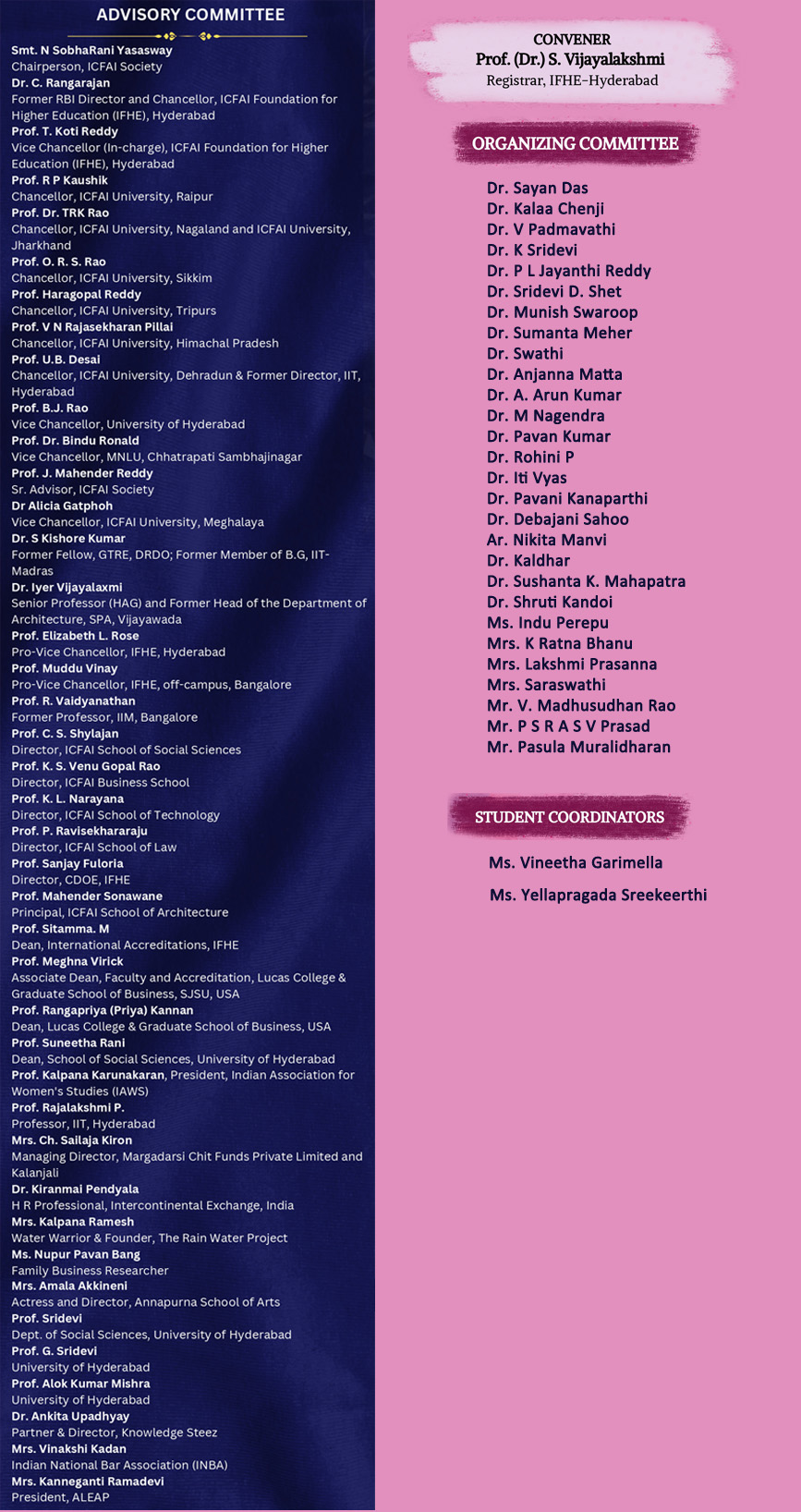
Conference Committee:
Accommodation
To encourage wider participation, the conference registration fee will be charged as given below:
A limited number of rooms may be available at
nominal rates on the campus of
IFHE-Hyderabad. The
rooms will be allocated on first-come-first-served basis. The delegates
can also choose to stay in
nearby hotels.
For reference purposes, the information regarding the Hotels will be
updated.
https://www.ifheindia.org/cwd
Email : i2cwd2026@ifheindia.org
Venue
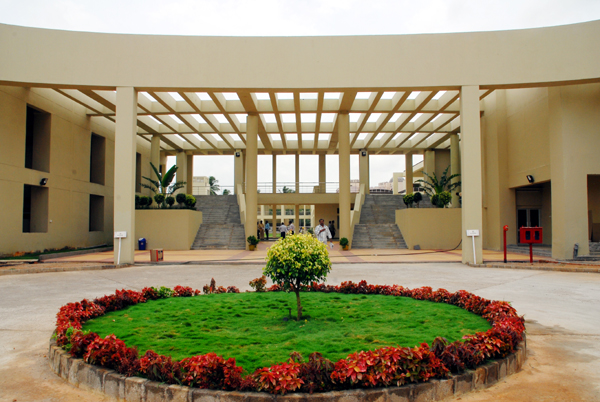
IBS
Business School, IFHE
University,
Survey No. 156/157, Donthanapally Village
Shankerpally Road,
RR District,
Telangana, India - 501 203
Registration Process and Fee Structure
To encourage wider participation, the conference registration fee will be charged as given below:
| Category | India | International |
|---|---|---|
| Academicians (Presenting Paper) | ₹ 5,000 + GST | USD 60 + GST |
| Research Scholars / Students (Presenting Paper) | ₹3,000 + GST | USD 40 + GST |
| Participation Fee (Non-Presenting Authors / Others) | ₹ 3,000 + GST | USD 40 + GST |
| Corporate Delegates / Policy Makers / Govt. Officials / NGO Professionals | ₹ 6,000 + GST | USD 70 + GST |
The conference registration fee includes a conference kit (comprising the Book of Abstracts, program schedule, etc.), accommodation, and all scheduled meals (including a gala dinner with a cultural night). It also includes a visit to nearby places during the conference days.
Participants registering after the November 15, 2026 deadline must arrange their own accommodation.
Once a paper is accepted, at least one of the authors must register for the conference and present the paper. Certificates will be issued only to registered participants (participation only). Registration Fee is non-refundable.
Two ways to be a part of the Conference
- Register & Submit Abstract — for those presenting a paper. You register and submit an abstract, and on acceptance make payment, and upload your full paper for peer review.
- Register for Participation Only — for delegates who wish to attend without presenting a paper. Complete your details and pay the participation fee; no abstract or paper is required.
Publication of Research Papers
Selected full length papers will be considered for publication in the regular/ special issues of the Journals indexed in Scopus and a Book (with ISBN No.). Structured abstracts of the papers selected for presentation will be published in the conference proceedings. Journal details will be updated on the conference website.
Journals/books:
-
Scopus-Indexed
Selected accepted research papers/articles will be published in a Scopus-indexed journal /book/book series, subject to the journal's editorial policies, plagiarism checks, and peer-review standards. Other details about the publication will be provided to the authors of accepted submissions through email. -
ABDC Listed Journals (Australian Business Deans
Council)
Selected and accepted research papers/articles will also be published in The IUP Journal of Accounting Research & Audit Practices, The IUP Journal of Applied Economics, The IUP Journal of Corporate Governance, The IUP Journal of Agricultural Economics, The IUP Journal of Managerial Economics, The IUP Journal of Monetary Economics, and The IUP Journal of Public Finance, subject to the respective journal’s editorial policies, plagiarism checks, and peer-review standards. -
Peter Lang International Academic Publishers:
Peter Lang has collaborated with the Conference as Publication Partner for publication in Edited Volumes of selected titles through a peer review process and publication standards, which will be processed for Scopus Indexing - Springer Nature: Edited Volume in Springer’s Scopus-indexed SDG series of selected titles.
- Publication Fee: Subject to the Policy / General Guidelines
Conference Venue:
ICFAITECH - Hyderabad Donthanapally,
Shankarapalli Road
Hyderabad - 501203, Telangana, India.
Our Partners


Chhatrapati Sambhajinagar

Media Partner

Research Partner

Publication Partner